Early Alzheimer's Evaluation
An educational guide for families and caregivers exploring early Alzheimer's evaluation options — early diagnosis, mild cognitive impairment assessment, and Cuba's comprehensive evaluation program. Information to support informed decisions, in consultation with your healthcare provider.
Educational Resource — Not Medical Advice
The information on this page is provided for educational purposes only and is not a substitute for professional medical advice, diagnosis, or treatment. Always consult with your qualified healthcare provider before making decisions about treatment options.
We do not target, identify, or retarget individuals based on health conditions. This content is intended for families and caregivers seeking information about international treatment options, and is discoverable through organic search.
The Importance of
Early Alzheimer's evaluation — at the stage of mild cognitive impairment (MCI) or early-stage dementia — provides the greatest opportunity to explore all treatment options and plan ahead. The Alzheimer's Association emphasizes that early and accurate diagnosis is valuable for patients and families.
Mild Cognitive Impairment
MCI is an early stage of cognitive change that may or may not progress to Alzheimer's. Evaluation at this stage provides a baseline and helps monitor progression.
Early-Stage Alzheimer's
Early-stage diagnosis allows families to explore all treatment options while the patient can actively participate in decisions.
Differential Diagnosis
Early evaluation helps distinguish Alzheimer's from other forms of dementia, reversible causes, and normal aging.
Treatment Planning
Early diagnosis opens the door to all available options — domestic and international — including Cuba's neuroprotective therapy program.
Components of
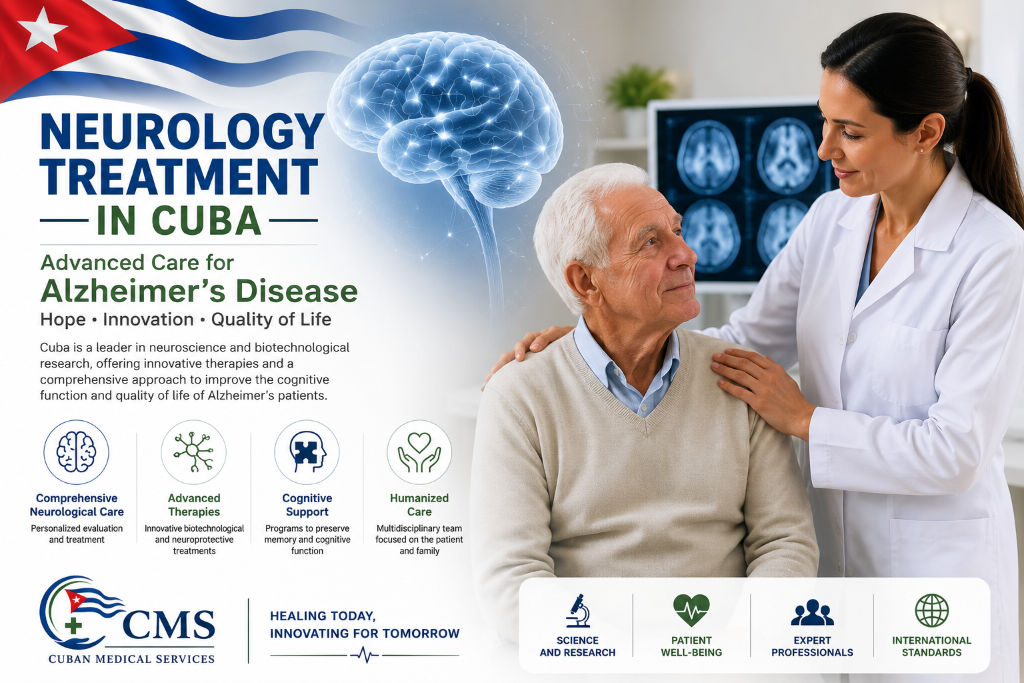
Early Alzheimer's evaluation is comprehensive and multidisciplinary. Cuba's program provides a thorough assessment designed to identify cognitive changes early and accurately.
Detailed Cognitive Testing
Sensitive neuropsychological tests that can detect subtle cognitive changes before they become obvious in daily life.
Neuroimaging
MRI to assess brain volume and rule out other causes; PET imaging for amyloid/tau where available.
Medical History
Review of risk factors, family history, medications, and symptom progression timeline.
Specialist Review
Neurologist consultation to integrate findings, provide a diagnosis, and discuss all available options.
Family Education
Education and support for family members on what the diagnosis means and what to expect.
Monitoring Plan
A plan for ongoing monitoring to track any progression and adjust care as needed.
NeuralCIM® — Advanced Therapy for Alzheimer's Disease
Supporting memory, preserving identity, restoring quality of life.
Cuban biotechnology, now within reach for patients from around the world. Speak with our coordinators about NeuralCIM Alzheimer's care in Cuba.
The Cuban Neuro-Care Program
Cuba has built a neuro-care program that combines its own biotechnology — NeuralCIM, a low-sialic-acid erythropoietin developed by the Center for Molecular Immunology — with intensive, multidisciplinary rehabilitation. This approach is not available in the United States.
- NeuralCIM neuroprotective therapy — a Cuban biotechnology innovation
- Intensive cognitive rehabilitation delivered by neuropsychologists
- Multidisciplinary team: neurologists, therapists, and specialized nursing
- 4–8 week individualized program cycles with continuous monitoring
- Coordinated aftercare and handover to your US physician
- English-speaking coordinators at every step
NeuralCIM®
Cuban biotechnology
Low-sialic-acid erythropoietin developed by Cuba's Center for Molecular Immunology (CIM), applied in neuro-care for its neurotrophic and neuroprotective properties.
4–8 Week Cycles
Multidisciplinary Team
Alzheimer's Care by State
Select your state for local Alzheimer's statistics, travel information, and state-specific educational resources for families and caregivers.
Alzheimer's Care Resources
Explore our full range of educational Alzheimer's care resources for US families and caregivers.
From First Inquiry to Safe Return Home
Contact Us
Share your medical information and history through our inquiry form or coordinators.
Free Evaluation
Our neurology experts review your US records and design a personalized treatment plan.
Travel Coordination
We assist with e-Visa, flights, and comfortable accommodation in Cuba for patient and family.
Treatment
Receive personalized neuro-care with continuous, multidisciplinary support.
Aftercare
Coordinated handover to your US physician with a long-term monitoring plan.
Your Questions Answered
Request a Free Clinical Evaluation
Share your medical information with our neuro-care team and receive a personalized evaluation — often within 24–48 hours. No obligation, no travel required to get started.